
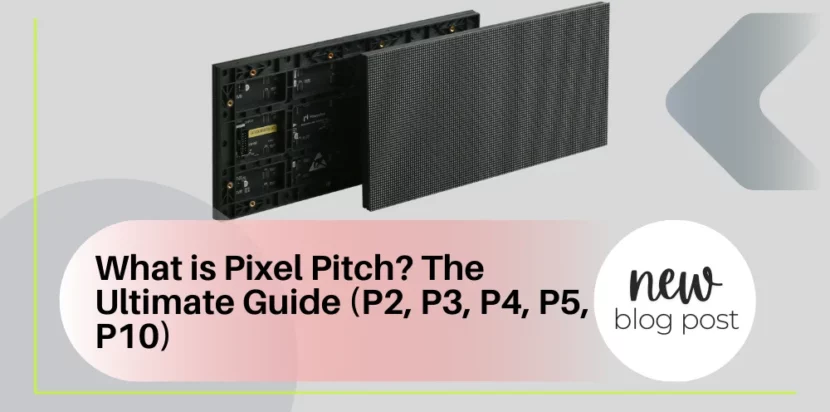
When investing in digital signage, whether for a retail store, a massive outdoor billboard, or a corporate lobby, you will immediately encounter a technical specification that dictates both the quality of your image and the price of your screen: Pixel-Pitch.
Understanding pixel-pitch is not just for technicians; it is a business necessity. Choosing the wrong pitch can result in a grainy image that repels customers, or conversely, an unnecessarily expensive screen that eats into your ROI. At BiasMD, we believe in empowering our clients with knowledge. In this guide, we will demystify pixel-pitch, explore the differences between common specifications like P2, P3, P4, P5, and P10, and help you select the ideal pixel-pitch for your specific needs.
Defining Pixel-Pitch: The Core of LED Technology
In the simplest terms, pixel-pitch (also referred to as dot pitch) is the physical distance, measured in millimeters, from the center of one pixel (an LED cluster) to the center of the adjacent pixel.
You will typically see this represented by a “P” followed by a number. For example, a pixel-pitch of P10 means there is a 10mm gap between the center of one LED and the next. A pixel pitch of P2 means the gap is only 2mm.
The Golden Rule of Pixel-Pitch:
- Lower Pixel Pitch = Higher pixel density, higher resolution, closer viewing distance, but higher cost.
- Higher Pixel Pitch = Lower pixel density, lower resolution, further viewing distance, and generally lower cost.
When you look at a screen closely, a low pixel-pitch appears as a solid, seamless image, whereas a high pixel-pitch might look like a grid of distinct dots.
Why Pixel Pitch Matters for Your Business
Your choice of pixel-pitch directly correlates to the human eye’s ability to resolve an image. If you install a P10 screen in a small conference room where viewers sit four feet away, they will see individual dots rather than a coherent image. This is known as “pixelation.” Conversely, installing a P1.5 ultra-fine screen on a highway billboard viewed from 500 feet away is a waste of budget; the human eye cannot appreciate that level of detail from that distance.
Selecting the right pixel pitch ensures you are paying for exactly the resolution your viewers can actually see. This balance is critical when browsing high-end solutions like the BIA Indoor SMD Screen.
Breaking Down the Common Pitches: P2, P3, P4, P5, and P10
To make an informed decision, we must analyze the most popular pixel-pitch options available in the market today.
1. P2 and P2.5 (High Definition / Indoor)
A pixel-pitch of 2mm or 2.5mm is the gold standard for indoor environments where the audience is very close to the screen.
- Best Use Cases: Corporate boardrooms, control rooms, luxury retail displays, and TV studios.
- Viewing Distance: The image looks crisp from as little as 2 to 3 meters away.
- Product Fit: These tighter pitches are often found in our BIA Ultra Thin SMD Screen series, providing a seamless visual experience that mimics a traditional LCD wall but with the brightness of LED.
2. P3 and P4 (Versatile / Semi-Outdoor or Large Indoor)
Moving up to a pixel-pitch of 3mm or 4mm offers a “sweet spot” for many businesses. It balances resolution with cost-effectiveness.
- Best Use Cases: Shopping mall atriums, houses of worship, school auditoriums, and airport signage.
- Viewing Distance: Optimal viewing starts at around 3 to 4 meters.
- Flexibility: P3 and P4 modules are frequently used in creative setups. For example, if you are looking to wrap columns or create curved displays, a BIA Flexible SMD Screen with a P3 or P4 pitch is an excellent choice.
3. P5 and P6 (Mid-Range / Outdoor Retail)
As we step into the outdoor arena, the pixel-pitch naturally increases. P5 (5mm) is currently one of the most popular choices for outdoor retail signage where pedestrians might walk relatively close to the screen, but it still needs to be bright and bold.
- Best Use Cases: Street-side advertising, digital menu boards (outdoor), and bus stop signage.
- Viewing Distance: Looks best from 5 meters (approx. 16 feet) and beyond.
- Durability: Outdoor screens with this pixel-pitch are built to withstand elements. You can explore robust options in our BIA Outdoor SMD Screen catalog.
4. P10 (The King of Distance / Large Billboards)
For massive highway billboards or stadium scoreboards, a pixel-pitch of 10mm (P10) remains the industry king. When a screen is 40 feet wide and viewed from a moving car 100 feet away, a tighter pitch is unnecessary.
- Best Use Cases: Highway billboards, stadium perimeter boards, and large building facades.
- Viewing Distance: Optimal from 10 meters (33 feet) to several hundred meters.
- Cost Efficiency: P10 allows you to build massive screen surfaces at a fraction of the cost of tighter pitches.
How to Calculate the Optimal Viewing Distance
One of the most frequent questions we receive at BiasMD is, “How far should my audience be?”
There are two methods to calculate the appropriate pixel-pitch based on distance:
- Visual Acuity Distance (The “Retina” Distance): This is the distance where the human eye can no longer distinguish individual pixels, and the image appears perfectly smooth.
- Formula: Pixel Pitch (mm) × 3000 = Minimum Viewing Distance (mm).
- Example: For a P4 screen: 4 × 3000 = 12,000mm (12 meters).
- Minimum Comfortable Viewing Distance: This is the closest distance where the image is acceptable, even if pixels are slightly visible.
- Formula: Pixel-Pitch (mm) × 1000 = Minimum Viewing Distance (mm).
- Example: For a P4 screen: 4 × 1000 = 4,000mm (4 meters).
If your customers will be standing 5 meters away from the screen, you technically could use a P10, but it would look blocky. A P4 or P5 would be the correct pixel-pitch choice.
Pixel Pitch and Resolution
It is important to remember that pixel-pitch determines the resolution of your screen within a fixed physical size. Imagine you have a wall that is 4 meters wide and 2 meters high.
- If you use a P10 pitch, you can fit fewer pixels into that space, resulting in a lower resolution.
- If you use a P2.5 pitch, you fit 4x more pixels into the same physical area, creating a Full HD or even 4K equivalent display depending on the dimensions.
For high-stakes visual environments, such as presenting detailed data or high-definition video, you must opt for a lower pixel pitch. High-quality components, such as those found in the BIA Nationstar SMD Screen, ensure that even at tight pitches, color uniformity and reliability are maintained.
The Future of Pixel-Pitch: COB and MicroLED
The LED industry never stands still. We are seeing a trend toward “fine pitch” LED walls, with pixel-pitch dropping below P1 (e.g., P0.9). Technologies like Chip on Board (COB) are allowing LEDs to be packed tighter than ever before, making LED screens viable replacements for traditional LCD video walls.
However, for 90% of commercial applications today, the standard range of P2 to P10 covers every need effectively. The key is not always chasing the lowest number, but finding the “right” number for your specific environment.
Choosing BiasMD for Your Display Needs
At BiasMD, we don’t just sell screens; we provide solutions. Whether you need a high-resolution BIA Indoor SMD Screen for your showroom or a rugged BIA Outdoor SMD Screen for a billboard, we guide you through the pixel-pitch selection process.
We understand that buying an LED display is a significant investment. That is why we recommend you verify the specs, compare the brightness, and always calculate the viewing distance before committing to a pixel pitch. You can even search for BiasMD online to see our presence and range of solutions.
Summary
To summarize, pixel-pitch is the distance between pixels in millimeters. It dictates the clarity of your screen and the minimum viewing distance.
- Indoors: Stick to P2–P4.
- Outdoors: Stick to P5–P10 (or P16 for very large displays).
- Budget: Tighter pixel-pitch costs more; balance your budget with your viewing distance requirements.
By understanding these fundamentals, you ensure your digital signage captures attention effectively without overspending on unnecessary resolution.
FAQs About Pixel-Pitch
1. What is the best pixel-pitch for a church or house of worship? For most houses of worship, the congregation sits about 5 to 10 meters back from the stage. In this scenario, a pixel pitch of P3 or P4 is the ideal balance. It provides clear text for lyrics and scripture without the high cost of a P2 screen. If the screen is used for IMAG (Image Magnification) and cameras are filming the screen, you may need a tighter pitch to avoid moiré patterns.
2. Does a lower pixel pitch mean a brighter screen? Not necessarily. Pixel pitch refers to resolution/density. Brightness is measured in Nits. You can have a P10 outdoor screen that is significantly brighter (6000+ nits) than a P1.5 indoor screen (800 nits). However, premium fine-pitch screens often use high-quality diodes like BIA Nationstar SMD Screens which offer superior color reproduction alongside brightness.
3. Can I use an indoor P2 screen outdoors? No. While a P2 pixel-pitch would look amazing outdoors, indoor screens lack the necessary weatherproofing (IP65 rating) and brightness levels required to compete with direct sunlight. For outdoor use, you must choose an outdoor-rated cabinet, regardless of the pitch.
4. How does pixel pitch affect the screen size? Pixel pitch doesn’t limit the physical size of the screen (you can make a P2 screen as big as a building if you have the budget). However, it dictates the resolution for that size. To achieve a native 1920×1080 (Full HD) resolution, a P2 screen would need to be 3.84 meters wide. A P4 screen would need to be 7.68 meters wide to achieve that same Full HD resolution.
5. Is P10 still good for 2025 standards? Yes, absolutely. For large-format digital billboards (e.g., 10ft x 20ft or larger) viewed from highways, P10 remains the industry standard pixel pitch. Using a P5 or P6 for such a long viewing distance offers diminishing returns and doubles or triples the cost unnecessarily.
Conclusion & Next Steps
Ready to visualize your project? Choosing the right pixel pitch is the first step toward a stunning display. Whether you need the razor-sharp clarity of a P2 indoor wall or the rugged durability of a P10 outdoor billboard, BiasMD has the expertise and inventory to bring your vision to light. Don’t guess—get the specs right the first time.
Contact BiasMD today for a free consultation and quote on your next LED display project. Let us help you calculate the perfect pitch for your business.
Comments are closed