
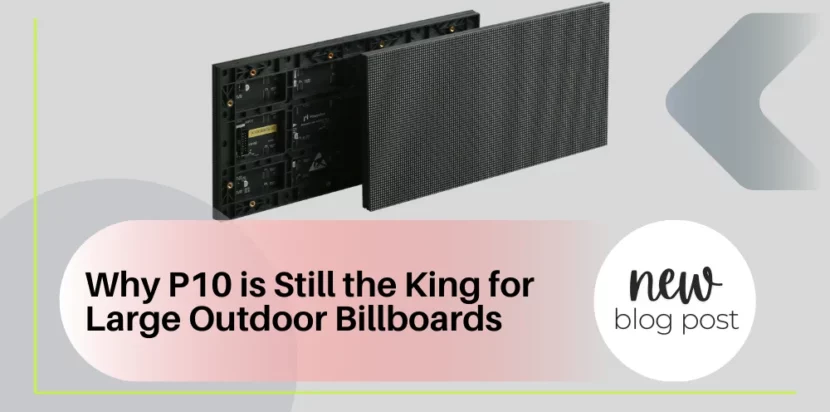
If you drive down any major highway, walk through Times Square, or look up at a stadium scoreboard, you are likely looking at a P10 Outdoor LED Display.
In the fast-paced world of technology, specifications usually become obsolete within a few years. Yet, the P10 standard (10mm pixel pitch) has held its ground as the “King” of outdoor digital advertising for over a decade. While indoor screens race toward P1.2 and P0.9, the outdoor market for large-format billboards remains steadfastly loyal to P10.
Why is this? Is it stubbornness? Is it a lack of innovation? Absolutely not.
At BiasMD, we supply the full spectrum of pixel pitches, from high-resolution outdoor P4s to massive mesh P16s. However, when a client comes to us with a project for a 40-foot billboard, we almost always point them toward the reliable, cost-effective, and visually stunning P10 Outdoor LED Display. In this article, we will explore the technical and economic reasons why P10 retains the crown and why it is likely the right choice for your next large-scale project.
Defining the Monarch: What is a P10 Outdoor LED Display?
To understand its dominance, we must first define the technology. A P10 Outdoor LED Display features a pixel pitch of 10 millimeters. This means the center of one LED pixel is exactly 10mm away from the center of the next.
In the past, P10 displays often used DIP (Dual In-line Package) technology, which featured separate red, green, and blue bulbs sticking out of the board. Today, the industry has largely shifted to SMD (Surface Mounted Device) technology, even for outdoor P10s.
Our BIA Outdoor SMD Screen solutions utilize these modern SMD capabilities to offer:
- Wider Viewing Angles: >140 degrees horizontal and vertical.
- Better Color Mixing: The RGB colors are mixed within the chip, not in the air.
- High Brightness: Capable of competing with direct sunlight (often 6000+ nits).
Reason 1: The Economics of Scale (Cost Efficiency)
The primary reason the P10 Outdoor LED Display reigns supreme is simple: Return on Investment (ROI).
Outdoor billboards are massive. A standard digital billboard size is often 14ft x 48ft (roughly 4 meters x 14 meters). This creates a surface area of nearly 60 square meters.
- The Cost of Density: If you were to build this 60sqm billboard using P5 (5mm pitch) modules, you would need four times as many LED lamps as a P10 screen. LEDs are the most expensive component of the display. Therefore, a P5 screen could cost nearly double or triple the price of a P10 screen.
- The Revenue Reality: Will advertisers pay you double because the resolution is higher? Likely not. An advertisement for a burger or a law firm looks virtually identical from the highway on a P10 screen as it does on a P5 screen.
For billboard operators, the P10 Outdoor LED Display hits the “sweet spot” where the screen is cheap enough to ensure a fast ROI, but the quality is high enough to satisfy top-tier advertisers.
Reason 2: The Science of Viewing Distance
The human eye has limits. This biological fact is the P10’s best friend.
There is a concept in the display industry called the “Visual Acuity Threshold.” This is the distance at which the gap between pixels becomes invisible to the naked eye, and the image appears perfectly smooth.
- The Formula: Pixel Pitch (mm) x 1000 = Minimum Comfortable Viewing Distance.
- For P10: 10mm x 1000 = 10,000mm = 10 Meters (33 feet).
Most large outdoor billboards are mounted on monopoles 20 to 50 feet in the air. Furthermore, the audience (drivers) is usually viewing the sign from hundreds of feet away.
At a viewing distance of 100 feet (30 meters), a P10 Outdoor LED Display looks like a seamless, high-definition canvas. Using a tighter pixel pitch like P6 or P4 for a highway billboard is scientifically wasteful; the human eye literally cannot resolve the extra detail from that distance. You would be paying for millions of pixels that disappear into the ether.
Reason 3: Brightness and Thermal Management
Outdoor screens face a brutal enemy: the sun. To be visible at noon on a sunny day, an outdoor screen needs to pump out at least 5,500 to 7,000 nits of brightness.
- Pixel Size Matters: In a P10 Outdoor LED Display, the physical space available for each pixel is larger (10mm spacing). This allows manufacturers to use larger, more robust LED diodes or drive them harder without overheating the board.
- Airflow: The wider spacing of P10 allows for better PCB board design and heat dissipation compared to extremely tight pitches like P3 outdoor, where heat can become trapped, leading to faster degradation.
Modern BIA Nationstar SMD Screen technology has pushed P10 brightness even further, ensuring that your content pops even in direct sunlight, while maintaining a long lifespan.
Reason 4: Durability and Maintenance
Outdoor screens must survive rain, snow, dust, and hurricanes. The P10 Outdoor LED Display is renowned for its ruggedness.
- Waterproofing (IP65/IP67): The module masks and potting (glue) processes for P10 are highly mature. Manufacturers have perfected the art of sealing these specific modules against moisture.
- Ease of Repair: If a module fails on a 50-foot tower, a technician has to climb up to fix it. P10 modules are generally larger and easier to handle than delicate fine-pitch modules.
- GOB Technology: While GOB (Glue on Board) is popular for indoor screens to protect against impact, standard P10 SMD masks provide excellent protection against physical damage from hail or debris without the extra cost of GOB.
P10 vs. The Contenders: Why Not P6 or P8?
You might ask, “Isn’t P8 better than P10?” Technically, yes, P8 has higher resolution. And for smaller outdoor signs—like a monument sign for a bank or a school that is viewed from the sidewalk—P8 or P6 is actually the better choice.
However, for large billboards (over 20sqm), the P10 Outdoor LED Display remains the king because of the “Diminishing Returns” law.
- Moving from P20 (old tech) to P10 was a visual revolution.
- Moving from P10 to P8 on a highway billboard is barely noticeable to a driver moving at 60mph.
If you have the budget for P8, we often advise our clients to spend that extra money on better quality LEDs (like Nationstar Gold wire) for their P10 screen, rather than buying a P8 with cheaper copper wire LEDs. Quality always beats quantity (or pixel density) in the long run.
Installation Scenarios: Where P10 Belongs
When should you commit to a P10 Outdoor LED Display? Here are the ideal scenarios:
- Highway Billboards: Any sign targeted at drivers.
- Stadium Scoreboards: Large screens meant for fans in the stands.
- Building Facades: Covering the side of a building with video.
- Roof-Top Advertising: Signs placed on top of buildings.
Conversely, if you are building a “drive-thru” menu board or a bus shelter ad, P10 is not the right choice. Those require P3, P4, or P5 because the viewer is only a few feet away.
The Role of BiasMD in Outdoor Advertising
At BiasMD, we don’t just sell modules; we engineer solutions. We understand that a P10 Outdoor LED Display is a 10-year investment.
We ensure:
- Energy Efficiency: Our modern P10 cabinets use energy-saving driver ICs (like MBI5124 or higher) to reduce electricity bills—a major operating cost for billboards.
- Lightweight Cabinets: We offer BIA Ultra Thin SMD Screen cabinets for P10, reducing the structural load on your monopole or building.
- Complete Systems: From the sending card to the video processor, we ensure the entire signal chain is optimized for the P10 resolution.
You can verify our market presence and see what others are saying by performing a search for BiasMD.
The Future of P10
Will P10 ever die? Eventually, perhaps. But not soon. As 4K content becomes ubiquitous, there is a slow drift toward P8 and P6 for premium locations (like Time Square low-level screens). However, for the vast majority of the global digital billboard market, the P10 Outdoor LED Display remains the gold standard of reliability and profitability.
It is the workhorse of the digital out-of-home (DOOH) industry. It pays the bills, it handles the weather, and it looks fantastic doing it.
Summary
To summarize, the P10 Outdoor LED Display holds the throne because:
- Cost: It offers the best ROI for large surfaces.
- Distance: It matches the visual acuity of highway viewers perfectly.
- Brightness: It easily combats the sun.
- Reliability: It is a mature, rugged technology.
Don’t overcomplicate your outdoor project. Sometimes, the industry standard is the standard for a reason.
FAQs: P10 Outdoor LED Displays
1. What is the lifespan of a P10 Outdoor LED Display? A high-quality P10 Outdoor LED Display, like those from BiasMD, typically has a lifespan of 100,000 hours. This translates to roughly 11 years of continuous operation. However, brightness usually decays to 50% after about 5-7 years depending on how hard the diodes are driven.
2. Can P10 screens play video or just images? P10 screens are fully capable of playing high-definition video (60fps). The limitation is not the motion, but the resolution. As long as your screen is large enough (e.g., at least 4 meters wide), a P10 screen can display video content beautifully.
3. What is the difference between DIP and SMD P10 screens? DIP (Dual In-line Package) is older technology where red, green, and blue bulbs are separate. It is very bright but has narrower viewing angles. SMD (Surface Mounted Device) combines all three colors into one chip. Modern P10 Outdoor LED Displays use SMD for wider viewing angles and sharper close-up image quality.
4. How much power does a P10 outdoor screen consume? Power consumption varies by brightness setting. On average, a P10 outdoor screen consumes about 250-300 Watts per square meter on average usage, with a peak consumption (showing an all-white screen) of around 700-900 Watts per square meter.
5. Do I need air conditioning for a P10 billboard? It depends on the climate. In very hot regions (like the Middle East or parts of Arizona), internal cooling fans or AC units inside the cabinet are recommended to prolong the life of the P10 Outdoor LED Display. In moderate climates, standard ventilation fans built into the cabinets are usually sufficient.
Conclusion & Next Steps
The P10 Outdoor LED Display is not just a piece of hardware; it is a business asset proven to generate revenue. Its dominance in the market is secured by its balance of price, performance, and durability.
If you are planning to install a large outdoor screen, do not feel pressured to overspend on high-resolution screens that your audience won’t appreciate. Trust the King.
Contact BiasMD today for a custom quote on your P10 billboard. We can help you design a structure, select the right brightness levels, and calculate your exact ROI.
Comments are closed