
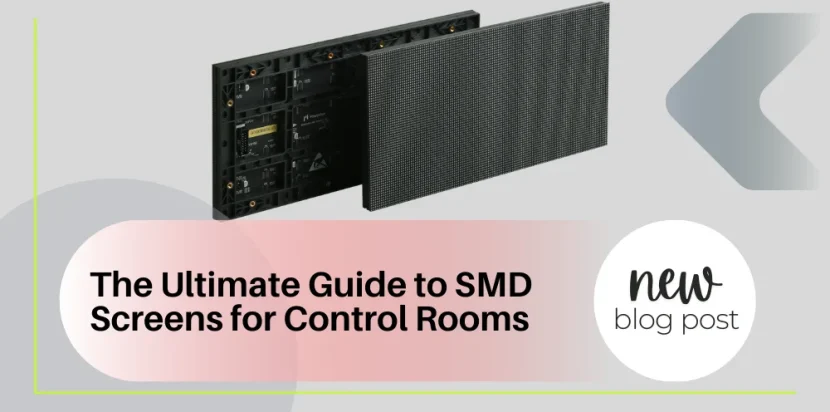
The control room is the brain of any major operation. Whether it is a traffic management center in a bustling metropolis, a security surveillance hub for a government facility, or a network operations center (NOC) for a telecom giant, the requirement is the same: absolute situational awareness. In these high-stakes environments, the display wall is not just a screen; it is a canvas where critical decisions are made. This is why the industry is rapidly standardizing on SMD screens for control rooms.
At BIA SMD, we understand that “mission-critical” means zero margin for error. Traditional LCD video walls with their intrusive bezels or projectors with their fading bulbs are no longer sufficient for the demands of modern data visualization. In this ultimate guide, we delve deep into the technology, benefits, and specifications that make SMD screens for control rooms the superior choice for 24/7 operations.
The Evolution of Command Center Visualization
Historically, control rooms relied on DLP rear-projection cubes or tiled LCD panels. While functional, they had significant drawbacks. LCD walls have “bezels”—the physical frames around each screen—that create a grid of black lines across the image. When monitoring complex maps, power grids, or fine-text data, these lines can obscure vital information.
SMD screens for control rooms eliminate this problem entirely. By using direct-view LED technology, modules are seamlessly docked together to create a limitless, bezel-free canvas. This ensures that a line on a map or a tracking vector continues uninterrupted across the entire wall. This “seamlessness” is not just aesthetic; in a crisis situation, clarity equals speed.
Why Pixel Pitch is Paramount
In a control room, operators sit for long shifts, often staring at the screen from relatively close distances. This makes “pixel pitch” the single most important specification when selecting SMD screens for control rooms. Pixel pitch is the distance between the center of one LED pixel and the next.
For command centers, we recommend “Fine Pixel Pitch” or “Narrow Pixel Pitch” (NPP) solutions.
- P0.9 to P1.2: Ideal for small rooms where operators are 3-5 feet away. This delivers a resolution that rivals standard computer monitors, allowing for the reading of small text and complex spreadsheets.
- P1.5 to P1.8: The industry standard for medium-sized control rooms. It offers a perfect balance of resolution and cost efficiency.
- P2.0+: Generally reserved for very large rooms where the wall is viewed from a distance (e.g., a large utility dispatch center).
Our BIA Ultra Thin SMD Screen series is specifically engineered for these environments, offering ultra-fine pitches that provide a “retina” display experience, ensuring zero eye strain for operators.
24/7 Reliability and Redundancy
Control rooms never sleep. A screen failure at 3 AM during a critical incident is unacceptable. SMD screens for control rooms are built differently than standard commercial displays. They are designed for 24/7/365 continuous operation.
Key Reliability Features:
- Power Redundancy: High-end setups include dual power supplies. If one fails, the other takes over instantly without a flicker.
- Signal Redundancy: If the main video cable is cut or fails, a backup loop ensures the image remains on screen.
- Heat Dissipation: Unlike projectors that get hot, modern SMD screens for control rooms have advanced thermal designs. Cool-running screens last longer and reduce the load on the room’s air conditioning.
Using high-grade components, such as those found in our BIA Nationstar SMD Screen, ensures that the LEDs do not degrade or shift color significantly over thousands of hours of use.
Superior Brightness and Contrast for Data readability
Control rooms are often well-lit environments. Operators need to read paperwork or use tablets while looking at the main wall. Projectors wash out under these conditions. SMD screens for control rooms emit their own light, offering brightness levels (600-1000 nits for indoor) that cut through ambient lighting easily.
More importantly, they offer superior contrast. “True Black” is essential for reading data. When a background is truly black (because the LED is off) rather than a glowing gray (like an LCD), colored text and alert icons pop with much greater visibility. This reduces operator fatigue and ensures that red “danger” alerts are spotted immediately.
Ergonomics: Protecting the Operator
Operator fatigue is a serious concern in control room design. Staring at a flickering or overly bright screen causes headaches and reduces concentration. SMD screens for control rooms from BIA SMD are equipped with high refresh rates (3840Hz or higher). This high refresh rate eliminates the imperceptible flicker that causes eye strain. Additionally, our screens feature “Low Blue Light” modes and wide viewing angles (160 degrees). This means an operator sitting at the far end of the console sees the same accurate colors and brightness as the operator sitting dead center.
Applications Across Industries
The versatility of SMD screens for control rooms makes them ubiquitous across various sectors:
- Traffic Management: Displaying hundreds of live CCTV feeds simultaneously to monitor congestion and accidents.
- Security & Surveillance: Large casinos, airports, and malls use these walls to track multiple targets across different cameras seamlessly.
- Utilities (SCADA): Monitoring power grids, water flows, or oil pipelines requires displaying vast, complex schematics that cannot be broken by bezels.
- Broadcast Control: TV stations use them for monitoring outgoing program feeds.
- Emergency Operations Centers (EOC): During disasters, these screens aggregate news feeds, weather data, and field reports into a Common Operating Picture (COP).
Space Efficiency and Installation
Real estate in a control room is expensive. Old rear-projection cubes required feet of space behind the screen for the “throw” distance. SMD screens for control rooms are incredibly slim. The BIA Indoor SMD Screen panels are lightweight and can be mounted directly onto a wall structure, saving valuable floor space.
Furthermore, they are front-serviceable. In a mission-critical environment, you cannot shut down the wall to fix a module. With front serviceability, a technician can use a magnetic tool to pop out a faulty module and replace it in under 30 seconds while the rest of the wall continues to operate.
Integration with Video Wall Processors
The screen is the canvas, but the processor is the artist. SMD screens for control rooms are driven by powerful video wall processors that allow for:
- Windowing: Placing a weather map in the top right corner, a news feed in the bottom left, and a main CCTV feed in the center.
- Roaming: Moving these windows freely across the canvas.
- Scaling: Enlarging a small detail to take up the whole wall during an investigation.
BIA SMD screens are compatible with all major processor brands, ensuring seamless integration into your existing IT infrastructure.
Cost of Ownership vs. Initial Investment
It is true that the initial capital expenditure (CapEx) for SMD screens for control rooms is higher than LCD walls. However, the Total Cost of Ownership (TCO) is often lower.
- LCDs: require bezel calibration, suffer from color drift (panels looking different over time), and have a shorter lifespan.
- Projectors: require expensive bulb replacements and filter cleaning.
- SMD: LED lifespans often exceed 100,000 hours (11+ years of continuous use). There are no consumables (bulbs/filters) to buy.
When you factor in the longevity and the lack of maintenance downtime, SMD screens for control rooms are the financially prudent choice for long-term operations.
The “Unbroken” View: Why Bezels Matter
We cannot stress enough the issue of bezels. In a SCADA environment (like an electrical grid map), a bezel line could hide a critical connection point or a break in a line. In a military context, it could obscure a drone feed detail. SMD screens for control rooms provide a truly seamless image. The module gaps are microscopic and invisible to the naked eye from viewing distance. This integrity of the image is vital for accurate data interpretation.
Choosing BIA SMD for Your Mission Critical Space
Designing a control room requires expertise. It is not just about hanging screens; it is about calculating power loads, viewing angles, thermal output, and signal paths. BIA SMD specializes in these high-stakes installations. We offer a range of products, including the BIA Flexible SMD Screen for curved control consoles that wrap around the operator for an immersive “cockpit” feel.
We invite you to verify our expertise and see how the industry searches for top-tier display solutions: Google Search for BIA SMD.
Future-Proofing Your Control Room
Technology moves fast. Investing in SMD screens for control rooms is a way to future-proof your facility. As resolution standards move from 4K to 8K and beyond, SMD walls can often be upgraded by changing the controller or replacing modules without rebuilding the entire mounting structure. This modularity ensures your command center remains state-of-the-art for a decade.
Conclusion
In the world of command and control, visibility is power. SMD screens for control rooms provide the reliability, clarity, and flexibility required to manage complex operations effectively. By eliminating bezels and offering superior brightness and lifespan, they have rightfully earned their place as the gold standard in the industry.
Don’t compromise on your view of the situation. Trust BIA SMD to equip your command center with the best. Visit biasmd.com/products/ to view our technical specifications.
FAQs
1. Why are SMD screens better than LCD video walls for control rooms? The main advantage is the lack of bezels. LCD walls have frames that create a grid, breaking up the image. SMD screens for control rooms are seamless, allowing for uninterrupted maps and data. They also offer better brightness and longer lifespans.
2. What is the recommended pixel pitch for a control room? For most control rooms, a pixel pitch between P1.2 and P1.5 is recommended. This allows operators to read fine text and data clearly from a seated distance of 5-8 feet. For larger viewing distances, P1.8 or P2.0 is sufficient.
3. Do SMD screens suffer from “burn-in” like OLEDs? High-quality SMD screens are very resistant to burn-in. However, in control rooms where static grids are displayed 24/7, we recommend using “orbiting” technology (shifting the image slightly) or periodically changing layouts to ensure uniform aging of the LEDs.
4. How is maintenance handled if a screen fails? SMD screens for control rooms are designed for “hot-swapping.” This means a technician can use a magnetic tool to remove a specific module from the front and replace it with a spare in seconds, without turning off the wall or disrupting the rest of the display.
5. Are SMD screens too bright for a dark control room? No. While they are capable of high brightness, professional SMD screens for control rooms have wide dynamic ranges. They can be dimmed down to very low levels (e.g., 100 nits) for night shifts without losing grayscale detail or color accuracy.
Secure Your Mission Critical Operations
When the safety of the public or the integrity of infrastructure is on the line, you need a display you can trust. Upgrade to SMD screens for control rooms and experience the difference of seamless, high-reliability visualization.
Contact BIA SMD today for a confidential consultation regarding your command center needs. Explore our high-performance displays at biasmd.com/products/.
Comments are closed