
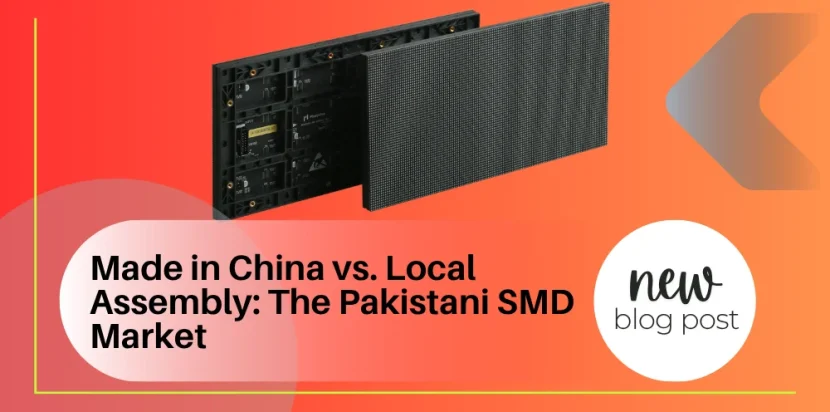
In the fast-paced, highly competitive landscape of commercial advertising and digital architecture, dynamic visual technology has revolutionized how businesses engage with their audiences. From towering highway billboards across major metropolitan areas to sophisticated, high-definition matrices integrated into luxury real estate developments in Lahore, the demand for premium visual real estate is unprecedented. However, as procurement managers and facility directors begin sourcing hardware, they are immediately confronted with a fundamental supply chain dilemma: choosing between a fully imported “Made in China” matrix and opting for localized SMD LED screen assembly.
This fundamental supply chain decision dictates far more than just the initial capital expenditure. The choice between imported hardware and local SMD LED screen assembly impacts the rigorousness of environmental weatherproofing, the baseline quality of the printed circuit boards, the reliability of the power distribution infrastructure, and the validity of long-term commercial warranties. The Pakistani digital signage market is flooded with varying grades of hardware, and failing to understand the exact engineering differences behind localized SMD LED screen assembly can lead to catastrophic hardware failures and severe budget overruns.
This exhaustive, highly technical 2026 blueprint is designed to completely demystify the local supply chain. By adhering to rigorous E-E-A-T (Expertise, Experience, Authoritativeness, and Trustworthiness) standards, we will deconstruct the engineering realities of imported versus local SMD LED screen assembly. We will explore the component sourcing, structural fabrication, quality control testing, and long-term maintenance implications to empower you to make an informed, highly lucrative investment for your enterprise.
The Global Supply Chain and the Core of Manufacturing
To accurately evaluate the merits of local SMD LED screen assembly, one must first understand the undeniable reality of the global electronics supply chain. Regardless of whether a commercial matrix is advertised as imported or locally constructed, the core micro-components—specifically the light-emitting diodes, the driving integrated circuits (ICs), and the central receiving cards—are almost universally manufactured in Shenzhen, China.
China is the undisputed global epicenter of optoelectronic manufacturing. Therefore, the debate surrounding local SMD LED screen assembly does not center on who invents the microscopic silicon chips. Rather, the debate focuses on where and how these raw components are soldered, calibrated, sealed, and integrated into their final die-cast aluminum or iron cabinets.
When a vendor pitches localized SMD LED screen assembly, they are importing raw, semi-finished printed circuit boards (PCBs) or individual unmounted modules, and completing the physical cabinet integration, wiring, and power supply mounting within Pakistan. Understanding this distinction is the first step in auditing the quality of any SMD LED screen assembly operation.
Understanding “Made in China” Factory-Direct Imports
A true “Made in China” commercial display is fully integrated, sealed, and optical-calibrated within a massive, highly regulated overseas manufacturing facility before being loaded onto a shipping container. There are massive engineering advantages to avoiding local SMD LED screen assembly in favor of factory-direct imports from top-tier global manufacturers.
First and foremost is uncompromising quality control. Top-tier Chinese factories utilize automated, robotic Surface Mount Technology (SMT) machines in strictly climate-controlled, static-free cleanrooms. This level of precision is rarely replicated in a standard local SMD LED screen assembly warehouse. Furthermore, a fully imported, elite BIA Nationstar SMD Screen undergoes rigorous laboratory stress testing. The fully assembled cabinets are baked in thermal chambers, subjected to high-pressure water jets to guarantee IP65 ratings, and put through intense vibration testing to simulate shipping stress.
Because these critical stress tests occur before the product ever leaves the factory floor, a fully imported display provides an unmatched level of baseline reliability. If you are deploying a delicate, ultra-high-resolution BIA Indoor SMD Screen for a corporate boardroom, the microscopic precision required for ultra-fine pixel pitches makes factory-direct imports significantly safer than relying on manual, local SMD LED screen assembly.
The Realities of Local SMD LED Screen Assembly
The local Pakistani market has seen a massive surge in vendors offering customized SMD LED screen assembly. The primary driving force behind localized SMD LED screen assembly is cost reduction. By importing individual, unbranded modules in bulk and bypassing the heavy import duties associated with fully finished, branded electronic cabinets, local vendors can offer a substantially lower initial price point.
In a typical local SMD LED screen assembly workflow, a vendor imports generic modules, low-voltage power supplies, and Novastar or Linsn receiving cards. They then source folded-iron cabinets from local metal fabricators. The physical wiring, the daisy-chaining of the power units, and the sealing of the rubber masks are all done manually on-site. While local SMD LED screen assembly provides rapid deployment times and lower upfront capital expenditure, it introduces severe engineering vulnerabilities.
The most critical vulnerability of localized SMD LED screen assembly is the lack of standardized environmental testing. A local warehouse cannot replicate a high-pressure water testing laboratory. Consequently, when a vendor promises an IP65 rating on a localized SMD LED screen assembly, it is often merely a theoretical rating based on the raw module’s specifications, not a certified guarantee of the final, manually assembled cabinet. This is why utilizing localized SMD LED screen assembly for a massive, weather-beaten exterior installation carries an exceptionally high risk of catastrophic water ingress. For guaranteed exterior resilience, a factory-sealed BIA Outdoor SMD Screen remains the industry standard.
Component Sourcing Risks in Local SMD LED Screen Assembly
Another major risk inherent to the localized SMD LED screen assembly process involves component batch matching. LEDs degrade over time, and every single manufacturing run has slight microscopic variances in color temperature and chromaticity.
Top-tier global manufacturers guarantee that every single module within a display originates from the exact same production batch. However, local vendors conducting SMD LED screen assembly frequently purchase surplus modules from various Chinese suppliers to cut costs. When these mixed-batch modules are spliced together during the local SMD LED screen assembly process, the final display exhibits a terrible, blotchy “patchwork” effect that completely ruins the aesthetic uniformity of the advertisement.
Furthermore, local SMD LED screen assembly frequently relies on cheap, copper-wire bonded diodes and unbranded transformers to lower the final quotation. These inferior components cannot withstand the intense thermal stress of the Pakistani summer, leading to rapid power supply burnouts and dead pixels within months of the initial SMD LED screen assembly.
Specialized Form Factors and Advanced Architecture
As architectural designs become more complex, the limitations of localized SMD LED screen assembly become glaringly obvious. If your corporate integration requires a sleek, non-standard aesthetic—such as wrapping a digital matrix around a cylindrical column in a high-end luxury residential lobby—standard local SMD LED screen assembly is entirely insufficient.
Bespoke shapes require highly advanced BIA Flexible SMD Screen technology, utilizing soft printed circuit boards and precise magnetic mounting structures. Local SMD LED screen assembly is generally limited to standard, rigid, flat rectangular panels. Attempting to engineer complex curves or utilize a precision-milled BIA Ultra Thin SMD Screen requires factory-level CNC machinery and automated optical calibration that local SMD LED screen assembly workshops simply do not possess.
Structural Fabrication and The Turnkey Solution
Whether you choose an imported matrix or a localized SMD LED screen assembly, the physical mounting infrastructure remains a vital component of your total budget. However, the quality of the cabinets drastically affects the structural steel requirements.
A localized SMD LED screen assembly almost exclusively utilizes heavy, locally fabricated folded-iron cabinets to house the electronics. These cabinets are incredibly heavy, prone to immediate rusting if scratched, and frequently suffer from poor physical alignment, resulting in visible seams across the final display. Because the local SMD LED screen assembly cabinets are so heavy, you must invest vastly more capital into over-engineered, hot-dip galvanized steel framing to safely support the matrix.
Conversely, premium imported solutions utilize ultra-lightweight, die-cast aluminum cabinets. These advanced cabinets offer seamless, zero-bezel splicing and drastically reduce the dead weight of the display, saving thousands of rupees in structural steel fabrication and heavy crane lifting during installation. Therefore, the cheap hardware quote of a localized SMD LED screen assembly is rapidly offset by the bloated physical infrastructure costs.
Evaluating Long-Term Warranties and ROI
The ultimate differentiator in the “Imported vs Local SMD LED screen assembly” debate is the long-term Return on Investment (ROI) and maintenance liability. Vendors offering cheap localized SMD LED screen assembly rarely provide robust, multi-year commercial warranties. If a power supply fails or a receiving card burns out in a cheap SMD LED screen assembly, the vendor often lacks the technical expertise or the matching spare parts inventory to execute a rapid repair, leaving your display dark for weeks.
In contrast, partnering with authoritative integrators who supply factory-direct, premium commercial displays ensures comprehensive, legally binding Service Level Agreements (SLAs). While opting out of localized SMD LED screen assembly requires a higher initial capital expenditure, the guaranteed longevity, flawless visual uniformity, and immediate access to batch-matched spare parts make imported premium matrices the only mathematically sound choice for serious commercial enterprises.
Making the Safest Commercial Investment
When navigating the complexities of the Pakistani digital signage market, transparency is paramount. If a vendor is quoting a localized SMD LED screen assembly, you must rigorously audit their component sourcing, their power supply brands, and their environmental sealing methodologies.
For businesses that refuse to compromise on visual brilliance and operational safety, bypassing unregulated SMD LED screen assembly in favor of factory-certified, globally recognized hardware is the ultimate best practice. By prioritizing E-E-A-T principles and investing in uncompromised engineering, you guarantee that your digital matrix remains a stunning, highly profitable revenue generator for a decade or more.
Frequently Asked Questions (FAQs)
1. Is local SMD LED screen assembly always cheaper than imported hardware? Initially, yes. Local SMD LED screen assembly bypasses finished-goods import taxes and utilizes cheaper, locally fabricated iron cabinets, resulting in a lower upfront quote. However, the frequent hardware failures, high power consumption, and lack of warranties often make local SMD LED screen assembly far more expensive in the long run.
2. Can local SMD LED screen assembly provide true IP65 weatherproofing? It is highly unlikely. Achieving a certified IP65 rating requires precise robotic silicone conformal coating and heavy-duty, airtight die-cast aluminum rubber gaskets. Local SMD LED screen assembly usually relies on manual sealing and standard iron cabinets, which frequently fail and allow water ingress during heavy monsoon rains.
3. Why does local SMD LED screen assembly often look blotchy or discolored? This is known as the “patchwork” effect, caused when a vendor performing localized SMD LED screen assembly mixes LED modules from different manufacturing batches. Because each batch has microscopic variances in color temperature, splicing them together during SMD LED screen assembly destroys the screen’s visual uniformity.
4. Does local SMD LED screen assembly use the same software as imported screens? Generally, yes. Both imported matrices and localized SMD-LED screen assembly rely on standard global control protocols like Novastar or Colorlight. The difference lies in the physical hardware—the receiving cards in a cheap SMD-LED screen assembly might be low-tier or pirated, restricting advanced software features and refresh rates.
5. How do I verify the quality of a local SMD-LED screen assembly? If you must utilize local SMD-LED screen assembly, demand absolute transparency. Ask for written proof that the diodes are gold-wire bonded (not copper), ensure the power supplies are from certified brands like Mean Well, and demand a written guarantee that all modules in your SMD-LED screen assembly belong to the exact same factory batch.
Do not compromise your commercial architecture with substandard hardware integration! Whether you are outfitting a high-end residential facade or a massive commercial advertising network, unverified localized SMD-LED screen assembly poses an immense financial and structural risk. Protect your capital and your brand’s prestige by partnering with the elite engineers at BIA. We provide uncompromising, factory-certified technology designed to outperform and outlast standard market offerings. Explore our robust, globally recognized display hardware at the BIA SMD Screens
homepage, or dive into our premium technical lineup via our Products Page
. Ready to secure a flawless, turnkey solution? Connect with our dedicated technical project managers immediately on our Contact Page
, and join our growing network of industry leaders on Facebook. Elevate your visual standards with BIA today!
Comments are closed