
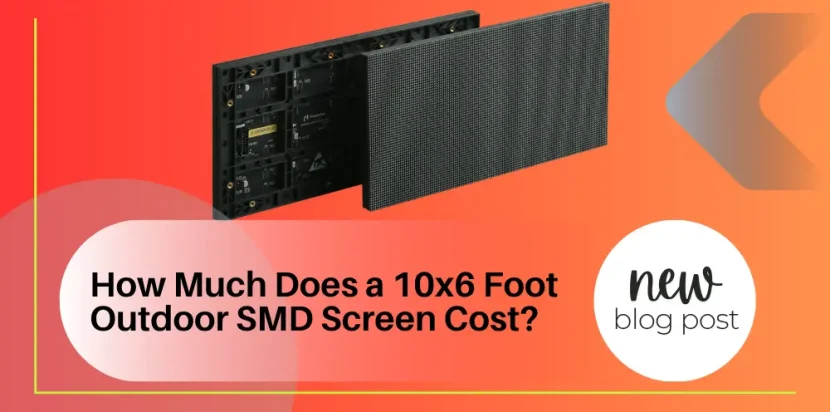
In the highly competitive commercial advertising landscape, digital signage has completely revolutionized how brands communicate with their audiences. A vibrant, high-definition digital billboard captures attention, delivers dynamic messaging, and provides an unparalleled return on investment compared to traditional static flex printing. Among the most popular sizes for retail storefronts, medium-sized commercial plazas, and drive-through advertising is the classic 10×6 foot dimension. However, before committing to a project of this scale, business owners and procurement managers must accurately evaluate the complete outdoor SMD LED screen cost.
Calculating the true financial investment for a commercial digital display is not as simple as checking a fixed price tag on a consumer television monitor. These displays are modular, highly customized architectural structures. The final price is dictated by a complex matrix of technical specifications, environmental protections, control infrastructure, and physical installation requirements. Relying on a vague “per square foot” estimate often leads to catastrophic budgeting errors, as generic quotes frequently omit essential components like heavy structural fabrication, advanced video processors, and commercial-grade power distribution units.
This comprehensive, highly technical 2026 buying guide is engineered to eliminate the guesswork from your procurement process. We will dissect every technical variable that influences the final outdoor SMD LED screen cost for a 10×6 foot installation. By adhering to rigorous industry standards and principles, this guide will empower you to make an informed, highly profitable technological investment for your enterprise.
Breaking Down the 10×6 Dimension and Square Meterage
The first step in calculating the outdoor SMD LED screen cost is converting the imperial measurements (feet) into the metric system (meters). This is a crucial step because the global manufacturing industry, component suppliers, and all technical pricing structures are based strictly on square meters, not square feet.
A 10×6 foot display represents exactly 60 square feet of total surface area. To convert this to square meters for an accurate hardware quotation, we divide by the standard conversion factor of 10.764.
- 10 feet is approximately 3.048 meters in length.
- 6 feet is approximately 1.8288 meters in height.
- 3.048 meters multiplied by 1.8288 meters equals 5.574 square meters.
Therefore, when you approach an AV integrator or manufacturer like BIA for a professional quote, you are essentially purchasing roughly 5.57 square meters of raw digital display technology. Because the base hardware is priced per square meter, knowing this exact metric figure is the absolute foundation for determining your total baseline outdoor SMD LED screen cost. Whether you are looking at a robust BIA Outdoor SMD Screen designed for a harsh plaza entrance or considering placing a high-brightness BIA Indoor SMD Screen just inside a large glass facade facing the street, the square meterage remains the primary multiplier for the entire project budget.
Pixel Pitch: The Largest Driver of Your Hardware Investment
Once you know the exact physical size of the digital display matrix, the next most critical factor influencing the outdoor SMD LED screen cost is the pixel pitch. In the technical realm of commercial display technology, pixel pitch is denoted by the letter ‘P’ (e.g., P4, P5, P6, P8, P10) and refers to the exact physical distance in millimeters between the centers of two adjacent light-emitting diodes on the printed circuit board (PCB).
Pixel pitch directly dictates the resolution, visual clarity, and pixel density of your display. A smaller number means the diodes are packed much closer together, resulting in a significantly higher resolution and a sharper image at closer viewing distances. However, a tighter pixel pitch also means exponentially more diodes, driving ICs (Integrated Circuits), and complex microscopic robotic soldering per square meter. Consequently, specifying a tighter pixel pitch drastically increases the raw hardware price.
For a 10×6 foot (5.57 sqm) exterior installation, the optimal pixel pitch depends entirely on the minimum viewing distance of your target audience:
- P10 (10mm): Ideal for highway billboards, building rooftops, or displays viewed from 10 meters (33 feet) or further. This specification offers the most economical outdoor SMD LED screen cost, as it uses significantly fewer diodes per square meter while remaining highly visible from afar.
- P6 or P8 (6mm – 8mm): This range is considered the “sweet spot” for most 10×6 foot commercial applications, such as retail storefronts, plaza directories, or street-level advertising. It perfectly balances sharp, high-definition resolution with a highly manageable capital investment.
- P4 or P5 (4mm – 5mm): Required only if your audience will be walking directly past the display or viewing it from less than 5 meters away. Because of the extremely high diode density required to maintain visual clarity at close range, selecting P4 will result in the highest possible hardware expenditure for this specific dimension.
Component Quality, Longevity, and Environmental Protection
Not all digital display components are created equal. The intrinsic quality of the raw materials directly impacts both the upfront price and the long-term operational lifespan of your matrix. The harsh exterior environment, characterized by extreme summer heat, direct UV radiation, and torrential monsoon rains, demands uncompromising component quality.
The specific type of light-emitting diode utilized during manufacturing is a major cost variable. Standard, generic modules often utilize copper-wire bonded diodes. While these are significantly cheaper initially, they are highly prone to internal oxidation and rapid brightness degradation under thermal stress. In stark contrast, premium commercial displays utilize gold-wire bonded diodes, such as those found in the elite BIA Nationstar SMD Screen. Gold wire ensures superior electrical conductivity, flawless color uniformity across the matrix, and an operational lifespan frequently exceeding 100,000 hours. Upgrading to premium Nationstar components will elevate your initial estimate, but it virtually eliminates the risk of premature failure and expensive maintenance call-outs.
Furthermore, the cabinet construction material significantly alters the price profile. Older, budget-friendly installations rely on heavy, folded-iron cabinets. These are inexpensive to manufacture but incredibly heavy and prone to rust if the paint chips. Modern, high-end commercial installations utilize precision die-cast aluminum cabinets. These advanced cabinets are ultra-lightweight, feature seamless zero-bezel splicing, and offer vastly superior heat dissipation to protect the internal electronics. While opting for die-cast aluminum increases the baseline hardware expenditure, it drastically reduces the need for massive, over-engineered structural steel supports.
Lastly, rigorous weatherproofing is non-negotiable. To achieve a certified IP65 or IP68 rating, the printed circuit boards must be heavily treated with specialized silicone conformal coating, and the module masks must be UV-resistant and perfectly sealed against moisture ingress. The rigorous laboratory testing and specialized manufacturing processes required to guarantee this high level of elemental protection naturally contribute to the overall pricing structure.
Structural Fabrication and Installation Infrastructure
A common pitfall for facility directors and procurement managers is focusing solely on the cost of the raw electronic hardware. The true, comprehensive outdoor SMD LED screen cost must account for the physical infrastructure required to mount the display safely and securely in a public space.
A 10×6 foot matrix is a substantial architectural element. Depending on the cabinet material chosen (iron vs. aluminum), the display hardware alone can weigh anywhere from 150 kg to over 300 kg. Mounting this kind of weight safely over a pedestrian walkway or along a busy road requires significant structural engineering and fabrication.
- Steel Fabrication: You will need a custom-welded, heavy-duty steel frame to anchor the cabinets securely to the wall or ground. For exterior environments, this structural steel must be hot-dip galvanized or treated with heavy anti-corrosion marine paint to prevent rust and degradation over the years.
- Wind Load Engineering: If the display is elevated high on a single pole (monopole) or mounted on a high-rise rooftop, the steel structure must be mathematically engineered by professionals to withstand high wind shear forces. This requires heavier gauge steel, specialized wind-bracing, and deep concrete foundations, adding to the total project expenditure.
- Labor and Logistical Logistics: Professional installation requires a team of certified riggers, master electricians, and specialized AV technicians. For elevated installations, renting heavy lifting equipment such as hydraulic cranes or articulating scissor lifts is mandatory, adding thousands to the final installation bill.
These structural fabrication and logistical deployment elements can frequently represent 20% to 30% of the total project budget. Always demand a transparent, turnkey quote from your vendor that explicitly includes physical installation to ensure your corporate budgeting is highly accurate.
Video Processors, Control Systems, and Power Infrastructure
The LED matrix itself is effectively a blank canvas; it requires a sophisticated, external control ecosystem to process and render your dynamic video content flawlessly. This peripheral hardware is a critical, unavoidable expense that must be factored into your calculations.
- Video Processors (Sending Cards): To display a seamless, perfectly scaled image, your matrix requires a dedicated video processor (such as those manufactured by industry leaders like Novastar, Colorlight, or Linsn). This device takes a standard video signal from a media player, scales it perfectly to your display’s custom pixel dimensions, and converts it into proprietary data packets. Advanced processors that support cloud-based remote management over 4G networks and asynchronous playback capabilities will add to your total budget but provide immense operational flexibility.
- Power Distribution Units (PDUs): A 10×6 foot high-brightness exterior display requires substantial, stable electrical current. You cannot simply plug it into a standard residential wall outlet. You must invest in a commercial-grade Power Distribution Unit equipped with high-capacity industrial breakers, voltage regulators, and heavy-duty surge protectors to shield your sensitive digital investment from grid fluctuations and lightning strikes.
- Industrial Cabling: Industrial-grade power cables and high-bandwidth CAT6 Ethernet or fiber-optic data cables are required to daisy-chain the individual cabinets together and connect the entire matrix back to the secure control room.
Depending on your comprehensive architectural needs, you might also require specialized display technologies that complement your main commercial billboard. For instance, if you are also designing a high-end corporate lobby alongside your exterior advertisement, integrating an innovative BIA Flexible SMD Screen around a pillar or a delicate BIA Ultra Thin SMD Screen along the wall will require separate, dedicated control processors and power systems, further expanding the scope of your technology budget.
Summary: Calculating Your Final Estimate for Maximum ROI
To arrive at the final, accurate number for your corporate budget, you must carefully synthesize all these technical variables into a single procurement strategy.
- Determine your exact total physical area (approximately 5.57 square meters for a standard 10×6 foot display).
- Select your ideal pixel pitch based entirely on your audience’s minimum viewing distance (P4, P5, P6, P8, or P10).
- Choose your hardware tier (standard copper-wire vs. premium Nationstar gold-wire diodes).
- Factor in the heavy structural steel fabrication, wind-load engineering, and professional labor.
- Include the advanced video control processors, receiving cards, and industrial power distribution systems.
While a high-end, turnkey 10×6 foot exterior installation represents a significant capital expenditure, it is a proven, highly lucrative revenue-generating asset. High-brightness, dynamic digital advertisements command massive premium ad rates and vastly superior audience retention compared to traditional static print media. By meticulously evaluating each technical component, you guarantee that your corporate capital is deployed intelligently, resulting in a reliable, stunning visual asset that operates flawlessly for years to come.
Frequently Asked Questions (FAQs)
1. What is the most expensive component contributing to the total outdoor SMD LED screen cost? The LED modules themselves, specifically the light-emitting diodes populated on the printed circuit boards, are the most expensive element. The tighter the pixel pitch (higher resolution) and the higher the quality of the diodes (like Nationstar gold-wire), the more expensive the hardware becomes.
2. Do I need permission to install a 10×6 foot digital billboard? Yes. In almost all commercial jurisdictions, installing a large digital advertising display requires municipal permits, structural engineering approvals, and strict compliance with local light pollution regulations. Factoring these administrative permit application fees into your total budget is highly recommended.
3. How much electricity does a 10×6 foot commercial display consume? Power consumption depends on the brightness levels and the specific content being displayed (bright white backgrounds consume significantly more power than dark black colors). Generally, a modern 5.57 sqm exterior display will consume an average of 1.5 to 2.5 kilowatts per hour, though peak consumption at absolute maximum brightness can be higher.
4. Can I reduce my overall outdoor SMD LED screen cost by buying indoor modules instead? No, this is a disastrous operational mistake. Indoor modules lack the necessary IP65 waterproofing, UV protection, and high-brightness capabilities required for exterior environments. Using indoor hardware outside will result in immediate catastrophic water damage and an unreadable, dim display under direct sunlight.
5. How long does a premium 10×6 foot digital display last? When utilizing premium high-end components, advanced aluminum cooling cabinets, and regular professional maintenance, a high-quality commercial digital display is rated for a half-life of 100,000 operational hours. This translates to roughly 7 to 10 years of continuous, 24/7 commercial operation before any noticeable brightness degradation occurs.
Ready to transform your commercial real estate into a high-revenue visual powerhouse? Navigating the intricate technical complexities of digital signage procurement requires deep expertise to ensure you maximize your corporate return on investment. Don’t leave your brand’s public visibility to chance or risk your advertising budget on subpar, uncertified components. Partner with the industry-leading engineers at BIA for uncompromising hardware quality, robust structural engineering, and fully transparent project pricing. To secure an exact, customized quote for your upcoming architectural integration, reach out to our dedicated technical team today via our Contact Page
. Explore our entire spectrum of advanced, high-definition hardware directly at the BIA SMD Screens
homepage, and be sure to join our professional network on Facebook for the latest successful installation showcases and advanced technological updates. Illuminate your business effectively with BIA today!
Comments are closed